
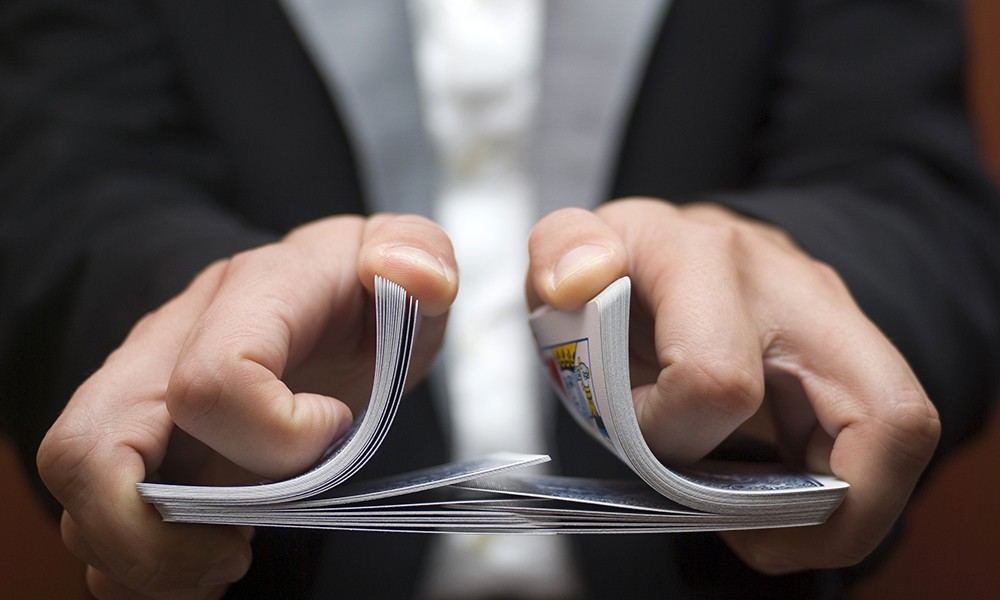

There’s a certain magic to shuffling a deck of cards, isn’t there? The swift movements, the crisp sound of cards slapping into place, each shuffle feels like setting the stage for a mystery-packed performance. But did you know that behind all that flair is some seriously cool math? Yes, probability is the star of the show, and it has a lot to say about the deck in your hand.
Please sit back, because we’re about to shuffle through some fascinating facts about cards and probability.
What Happens When You Shuffle?
First off, shuffling isn’t just about mixing up the deck so everyone gets a fair shot at winning. Shuffling is also what makes every game feel fresh and unpredictable. But here’s the kicker, a deck of 52 cards can be arranged in 52! (that’s 52 factorial) ways. For those who don’t speak math fluently, 52 factorial is 52 x 51 x 50 x 49… all the way down to 1.
The result? A number with 68 digits. To put it simply, the number of unique ways to shuffle a deck of cards is unfathomably large, so large, in fact, that the arrangement you create after a really good shuffle has probably never existed before in human history. Crazy, right?
The Power of Randomness
Now, why does randomness matter so much? Probability is all about understanding chance, and in a card game, randomness is what keeps everyone honest. Without it, skilled players might exploit patterns in the deck to gain an advantage, and suddenly, the luck of the draw wouldn’t feel so lucky anymore.
When you shuffle a deck properly (and we’ll touch on what “properly” means in a bit), every card has an equal probability of landing in any position. It’s this even distribution that gives all players a fair chance. Imagine playing poker with an unshuffled deck where the cards are still in order, hands of three Queens or a Royal Flush would no longer be thrilling; they’d just be expected. Boring, right?

How Many Shuffles Are Enough?
If you’ve ever wondered how many shuffles it takes to truly randomize your deck, mathematicians have looked into that too. The general rule? You need seven riffle shuffles to ensure the cards are well-mixed, statistically speaking. Anything less, and patterns from the prior arrangement could still linger. But hey, if you’re just playing a casual game of Go Fish at home, no one’s going to call you out for stopping at five shuffles. We’re not all mathematicians, after all.
Card Counting and the Influence of Probability
We can’t talk about cards and probability without at least mentioning card counting, because, yes, some people have figured out how to use probability to beat the odds. Card counting is essentially about keeping track of which cards have been played so you can predict which cards are still left in the deck. Brilliant, isn’t it?
Of course, card counting is most famously applied to blackjack. By assigning values to low, medium, and high cards, players track the deck’s “hotness” or “coldness” to determine their bets or strategy. But here’s the catch, for this to work, the deck has to be shuffled minimally or not at all during play. That’s why casinos introduced continuous shuffling machines and multi-deck games to thwart those sneaky mathematicians.
The Odds of Iconic Hands
Let’s shift gears and look at poker for a minute. Ever wondered what the odds are of being dealt a Royal Flush right off the bat? It’s pretty rare, specifically about 1 in 649,740 hands. A Full House? That’s a more reasonable 1 in 693 probability. These odds explain why you’re more likely to hoot and holler when you land a premium hand like these, they don’t come around often!
But that’s where probability spices things up. It keeps you on the edge of your seat, knowing that the unlikely is always possible and the impossible isn’t quite as far-fetched as it seems.
Conclusion
Probability isn’t just for statisticians and casino pit bosses. Whether you’re playing for fun or purely for the thrill, knowing the odds can make your experience even richer. It’s what gives card games their edge, their drama, and their infinite replayability. No two games are the same because no two shuffles are. That’s the beauty of probability in the world of cards, it’s math disguised as magic.
So, the next time you’re at the table, take a moment to appreciate the dance of randomness at your fingertips. Every shuffle, every card draw, and every surprising hand is all thanks to the wonders of probability. And who knew math could be this much fun?
Leave a Comment